


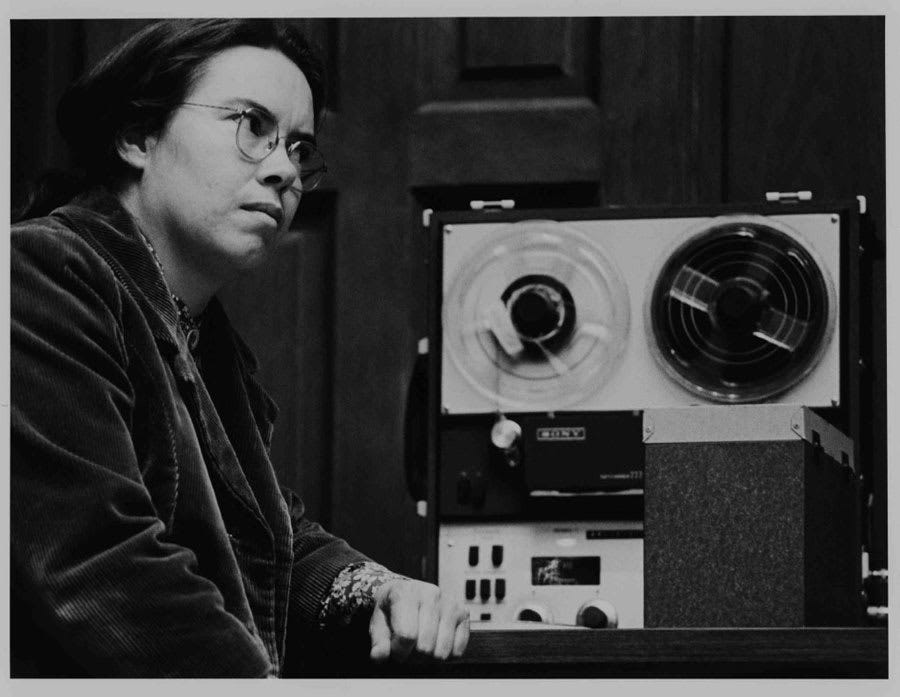
Sometimes, the most important books find you when you’re not looking. I came to Pauline Oliveros the old-fashioned way. After work, in Carin and Teamy’s office, I was winding down, not searching for anything. A small blue book on the desk caught my eye: Quantum Listening. Its simplicity - cover, title, and size - drew me in. I picked it up, read a few pages, and didn’t put it down for a while.
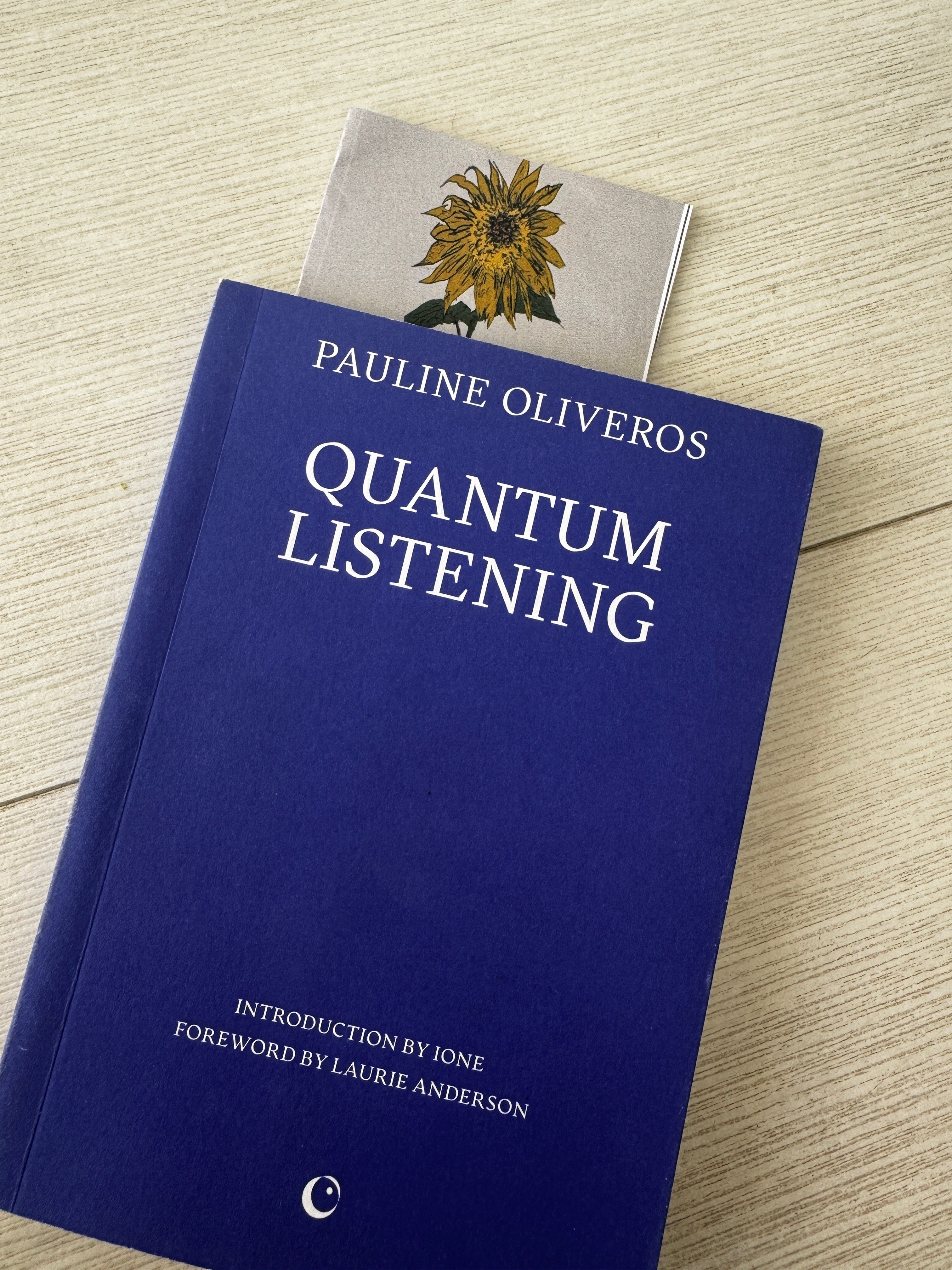
Note the strategically placed bookmark: it’s from a first pass at the new Seeds covers, and it marked my place as I read.
The book came from Well Read, a curated space in Lisbon. There, someone decides what matters and arranges books where you might stumble across them. Although I’d picked up ‘Quantum Listening’ elsewhere, the feeling of that kind of serendipitous discovery is unique to physical spaces like Well Read and why we still need them so much. Certain discoveries only happen that way. No method would have led me there. No recommendation engine has the patience for a small blue book sitting quietly on a desk at the end of the day. Now that I know more about her, I think Oliveros would have appreciated this: real listening, like real reading, needs a space slow enough to receive it.
That evening, once home, I shifted almost without noticing from the accidental find of the book to a different kind of search - this time via algorithms. Intrigued by what I’d read, I began following a thread I hadn’t pulled before. My curiosity led me to ‘Deep Listening’ - the cistern recordings, the drone pieces. Suddenly, I realised this whole world had been humming quietly, waiting below the surface for me to find it.

Photography: Centrum Foundation
The recording is called Deep Listening. It was made on October 8, 1988, at the bottom of a disused military water cistern in Fort Worden, Washington State. This concrete cylinder was built in 1907. It is 186 feet in diameter and 14 feet underground. It was designed to hold two million gallons of water and withstand bombing. Oliveros and two collaborators—trombonist Stuart Dempster and vocalist Panaiotis - climbed down a ladder through a small manhole. They began to play. No audience. No setlist. Just the three of them, their instruments, and a space with a reverberation time of 45 seconds. (Deep Listening Band, 2026)
Forty-five seconds. Every note played remained in the air for almost a minute before fading. The cistern was more than a venue; it was, in essence, the instrument.
What they were doing, Oliveros later said, was “learning to play the space itself.”
It's a sensibility that others were finding their way toward independently. In 2000, a Montreal artist duo called [The User] - Thomas McIntosh and Emmanuel Madan - turned Silo #5, an abandoned grain elevator in the city's Old Port, into something similar: a communal instrument, open to anyone. They wired it with microphones and speakers, gave it a phone number (+1 514 844 5555), and let the world play it. The structure had a reverberation time of over twenty seconds - the building doing to sound what the cistern did, but from a call box. Hundreds of thousands of people dialled in. (Thanks to Teamy for flagging this after reading this piece for me. Note to self OUT LOUD, research an extended piece on acoustic spaces as instruments)
“Can you imagine listening so intently that the room itself becomes a collaborator? Sometimes I wonder how often we let our surroundings shape what we hear, or if we mostly tune them out.”
The album is 63 minutes of accordion, trombone, didgeridoo, voice, conch shells, and garden hose. Long tones dissolve. Sounds blur where one ends, and another begins - like moving through a dream. Listening feels as if wading into warm, deep water in the dark. I sat with it for an hour and emerged as if I’d slept. That effect - the weird feeling of resurfacing from a dream - was, I soon learned, not a coincidence but an intended part of the experience. Learning this deepened my understanding of what I was hearing.
Who was she? Pauline Oliveros was a Tejana composer, accordionist, and philosopher. She grew up in Houston, bewitched by cicadas and neighbourhood frogs. She co-founded the San Francisco Tape Music Centre in the 1960s…
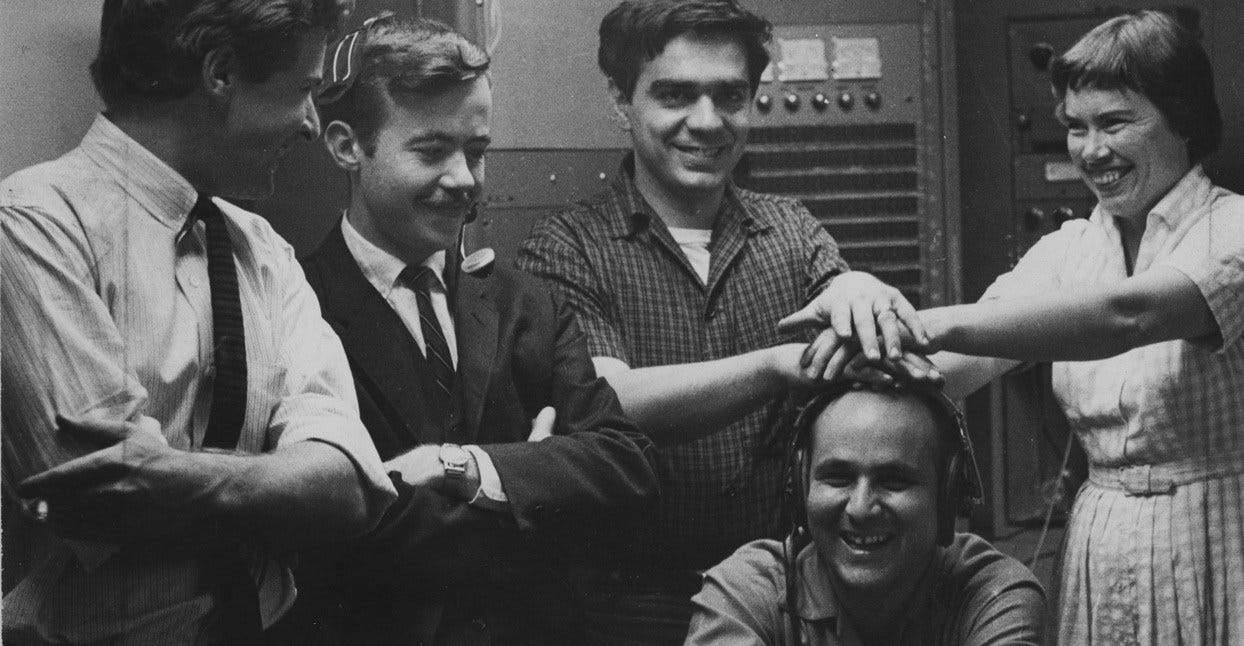
She spent the rest of her life - she died in 2016 at 84 - building Deep Listening. In later years, she shared that life with IONE, a sound artist and poet. Together, they created music theatre and dream research projects. Oliveros’s work wasn’t just about thinking; it rested on the idea that listening or ‘hearing’ happens involuntarily. The ear picks up sounds automatically. Listening is choosing to notice what’s already present.
Deep Listening was her way of bringing out this in-between state, making listening last so long that it was almost like being held in a waking dream - a way to stay open to both what you notice and what is just below the surface.
What Oliveros encouraged - in the cistern, steady accordion pieces, and Sonic Meditations with a women’s group in the early 1970s - was likely a brain state dominated by alpha waves: “relaxed alertness” or “flow,” marked by calm, thoughtful activity. Alpha waves move 8 to 13 times per second—a mental twilight, softer awareness, an open mind, between wake and sleep. Below alpha is theta (4 to 8 times per second)—the realm of dreams, gut instincts, drifting before sleep, moments when morning images linger. Theta dominates during REM sleep. Research on remembering dreams finds '“frontal theta activity directly governs whether we can bring those nocturnal experiences back on waking.’” The dreaming brain uses the same tools for dreams and for deep creative thought.
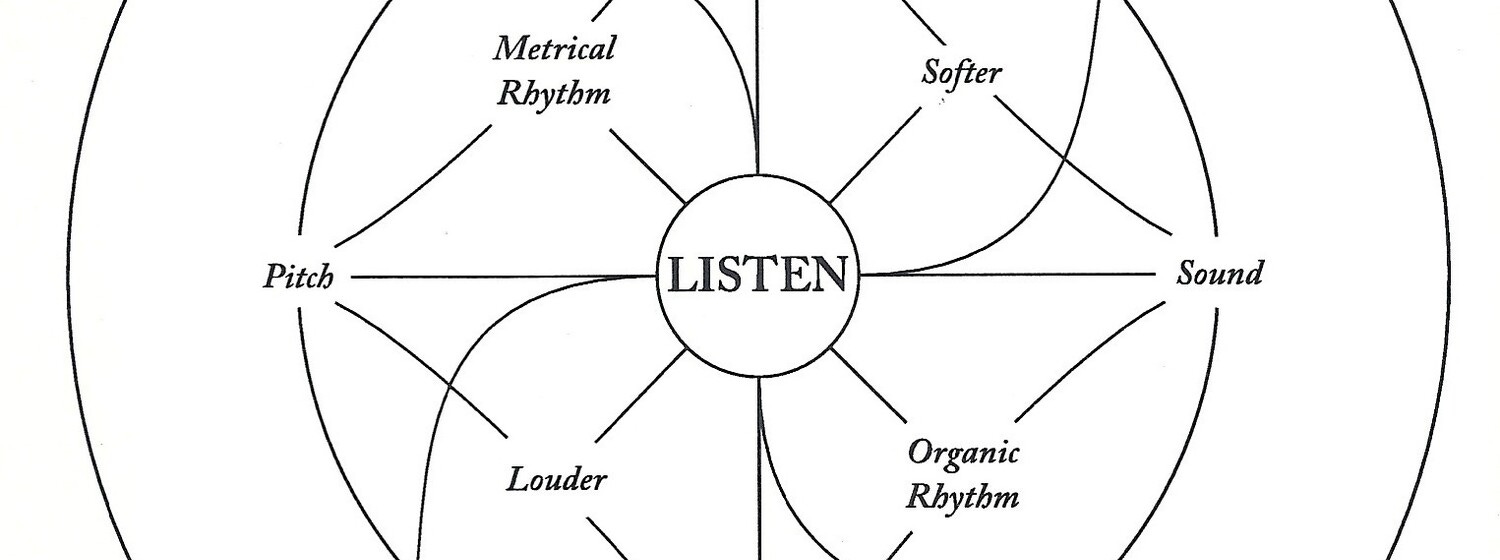
Oliveros, without using brain scans, taught people to notice that state while awake. Long, steady sounds guide the mind - they keep a steady pace, leading it through alpha waves and toward something slower and deeper.
A note on the 70s, quickly, because it’s an era that has been misread. The New Age movement flourished around Oliveros’s early work. It notoriously extracted contemplative practices from their Indigenous and Eastern origins, flattening them into commodified wellness aesthetics: crystals, chakras, brainwave cassette tapes sold in health food stores. It’s a residue that still contaminates any conversation that brings up the words “vibration” and “consciousness” in the same breath.
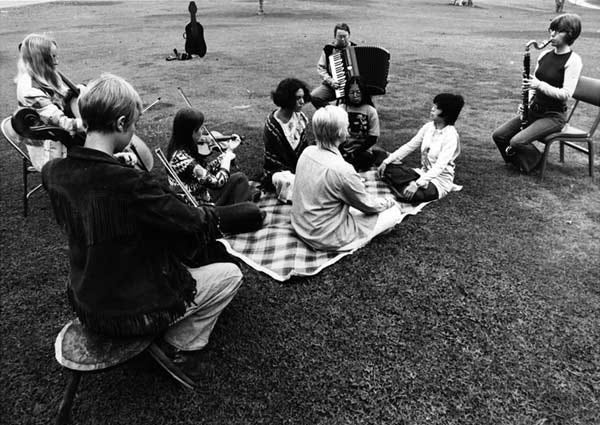
Oliveros went the other way. She created Sonic Meditations with a feminist group after months of experimentation - both political and musical.
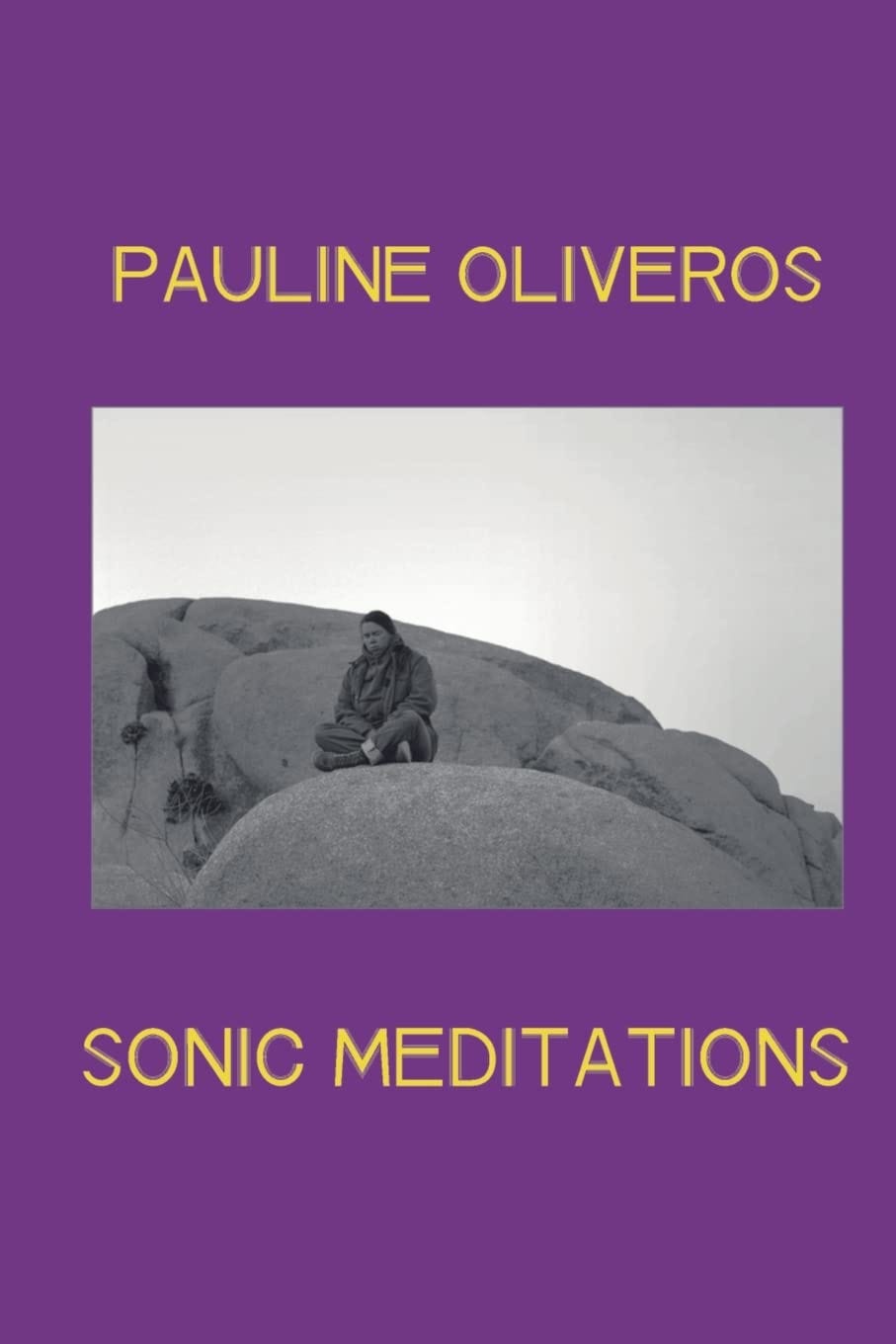
She worked with physicist Lester Ingber on how people pay attention when listening. She developed new methods: drone music, underground cisterns, and hearing research. She didn’t borrow spiritual ideas she hadn’t earned; she built her own from basic concepts and real experience. The term ‘meditation’ hides what she truly did - her work was more unusual and precise than that word suggests.
Later in her life, Oliveros went further. In her 1999 essay - republished as the slim manifesto ‘Quantum Listening’, with a foreword by Laurie Anderson - she pushed the idea into stranger territory. for decades - both central figures in American experimental music, both working at the crossroads of technology, performance, and consciousness, both sharing a conviction that listening was something Western culture had systematically undervalued.
They performed together, improvising live to a screening of a silent film at EMPAC in 2013. Oliveros was on accordion, Anderson on electric violin. They also appeared together in the 1993 documentary The Sensual Nature of Sound, a portrait of four women who had quietly remade the terrain of American music. (The Films of Laurie Anderson, 2013)
When a later documentary about Oliveros’s life was released, Anderson contributed a single-word review: Luminous.
Oliveros, in Quantum Listening, says that we have become a society that mostly pays attention to what we see. Hearing is treated as something extra. Her best example is NASA. In 1998, they sent a $165 million Mars probe with a $15 microphone from a hearing aid, almost as an afterthought. The sounds of another world: an extra. This is even more striking when you know that Anderson later became NASA’s first artist-in-residence. She was not a scientist or an engineer. She was an artist. The agency that didn’t think to listen to Mars brought in the woman who spent thirty years listening to everything else.
‘Quantum Listening’, she wrote, is “listening to more than one reality at once, in as many ways as possible. “Changing, and being changed by, the act of listening itself - hearing microscopic detail and the entire field simultaneously.
Her main point: hearing is sidelined in modern life. We are, she says, “a visually oriented society.” The ear tells the eye where to look, but the eye dominates. Research on machine vision advances faster than on hearing. We bring cameras to the zoo, not recorders. Zoos aren’t even open at the best times for sound - early mornings and evenings, when animals are loudest. The birds on my Lisbon terrace, as the weather improves, prove this point.
She says ignoring hearing isn’t harmless. Not listening leads to isolation. She asks, ‘What if you could hear colours? What if we launched a satellite microphone to listen to space?’ An electron microscope lets us see tiny structures. But we could also listen to the micro world and reveal a universe shaped by quantum physics.
Oliveros saw a comparison. What we notice through listening is not set or just waiting for us. It is partly defined by how we listen and pay attention. What we hear depends on how we listen. Which is a very unusual idea: “The quantum listener listens to listening.”
Listening to listening. Not just paying attention to the world, but turning back to notice how you are paying attention. You become aware that you are aware, watching your mind at work. It’s like a feedback loop for your mind. The brain gets quiet enough to notice what it is doing, letting you watch yourself think.
Then there’s the Tuning Meditation.
Written in 1971 and later expanded into The World Wide Tuning Meditation (2007), the instructions are almost absurdly simple. Take a deep breath and let it all the way out with a sound. Listen with your mind’s ear for a tone - internally, amid the silence. On your next breath, using any vowel sound, sing the note you silently perceived. Then listen to the whole field of sound the group is making. Find a voice distant from you and tune to it as exactly as you can. Then contribute a new tone - one that nobody else is singing.
Oliveros performed a version at St John’s Smith Square in London in June 2016, just after the Brexit result, and the feeling of community that flowed through the room as the audience sang together was described as genuinely palpable. When the piece was revived as a global Zoom event in the early weeks of lockdown in spring 2020, it reached over 4,600 participants from all seven continents and more than 30 countries. (Deep Listening: The Story of Pauline Oliveros, n.d.) Thousands of people, alone in their homes, breathing and listening together, singing tones they’d imagined internally, tuning to strangers they couldn’t see, building a shifting chord-mass from nothing but breath and attention.
It is, in the most direct sense, a network spanning many people. A living system composed of individuals paying close attention to one another. Which brings us, finally and not by accident, to plants.
It turns out that plants are electrically active in ways that are surprisingly similar to the sound worlds Oliveros explored. They don’t have nervous systems like animals, but they constantly send and receive tiny electrical signals - small currents through their cells, changes in voltage that let them sense and respond to their environment. These signals occur at frequencies very close to the alpha and theta ranges, where the human mind is most open.
Some researchers have started turning these tiny electrical signals to sound through a process called biosonification (Brian d’Souza, we’re looking at you): wires on leaves pick up small electrical changes - caused by photosynthesis, water moving, and reactions to light and touch - and turn them into digital data that becomes music. The result is slow, calm, always changing, and never exactly the same. Oliveros, in Quantum Listening, imagined this exact idea: that we could listen to the tiny world through instruments, the way we already see it through powerful microscopes—and, by doing so, find a strange universe that cameras could never show us.
Plants also react to sound, and not by accident. Roots grow toward the vibration of running water, even when there is no water, finding their way by sound instead of by what they touch.
‘Plant roots were able to detect sounds and also to grow towards the source of the sound.’
Prof. Stefano Mancuso, researcher,
Flowers make sweeter nectar within minutes of hearing the low buzz of bee wings. Plants that feel the vibrations of caterpillars eating start chemical defences they do not use against wind or birdsong - which means they are not just reacting to any noise, but telling different sounds apart with great accuracy. The world below what humans usually notice is full of activity. Some of the most important communication in nature happens at sound levels most of us have learned to ignore.

Kate Brown’s Tiny Gardens Everywhere - a history of city gardening recently featured by Caught by the River, whose festival at Elmley we’re proud to be part of this May—makes a similar point in a different way: a plant is not simply an object, not just decoration, but something that naturally connects things. Gardens, wherever they are and whatever they look like, tend to create what she calls “communities that are biological as well as social”—a rich mix of connections that help people get by. The communities that form around growing things are, she finds again and again in different times and places, some of the strongest we have. Which is, when you think about it, exactly what a forest already knows.
Then think again about the Tuning Meditation - all those voices distributed across a network, each one listening carefully, each one contributing a tone that nobody else is singing. It starts to seem less like a metaphor and more like a description of what a garden is already doing, continuously, whether we’re attending to it or not.
Oliveros understood this, even without the research.
Her cistern recordings sent sound back into the ground - to stone, soil, and packed earth, the world of roots and fungi. She talked about listening with the whole body, through the feet as much as through the ears. “Sometimes I try this when I’m walking: How much of the world can I hear if I let my attention sink down, out of my head, into my body?”
Through practice, she was reaching for a way of paying attention that took less and gave more, involved less ranking things, and was more about being part of nature. Not the position of someone looking down at what they study, but letting that difference disappear completely.
Maybe that’s the point: to stop being a spectator and become part of the field itself.

It’s a way of being that the environmental health researcher Yoshifumi Miyazaki has spent decades trying to measure. His work on shinrin-yoku - forest bathing, the Japanese practice of walking slowly through the woods without rushing - has found that spending time among trees causes real changes in the body that Oliveros’s practice also aims for. Stress hormones go down. Blood pressure drops. Heart rate becomes steady. And brain activity moves toward the alpha range - that same relaxed, open state that long, steady sounds help create from the inside. Miyazaki’s main point is simple and a bit surprising: our bodies still know that nature is home. Not solely as a symbol. Physically. The nervous system knows where it is and reacts accordingly.
What Oliveros was doing in the cistern - going down into the earth, letting such echoes blend single notes into something flowing and alive - was, in its own way, like forest bathing for the ears. A return to the ground. A reset. The slow, careful attention that both practices need is not merely a treat or an escape. It’s a way of being that the body, it seems, has been waiting for all along.
Inside Quantum Listening, she puts the stakes plainly: the devaluation of hearing through unconsciousness has caused a serious imbalance in the quality of life. Suppression of listening, she writes, leads to separation and alienation. We need, she says, to be “listening in all possible modes to meet the challenges of the unknown - the unexpected.” Feels like, in 2026, just like a line written for now.
What she offers - as brain scientists study how dreams are stored by theta waves, as bio-sonification artists let birch trees and ferns make music, as plant scientists find that roots find their way by vibration—is less a method and more a way of being. It is a willingness to slow down enough to notice what is already being sent out.
The alpha state is not a retreat from the world. It’s the frequency at which the world becomes audible.
The question, as always, is whether we’re paying close enough attention to hear it. 🌿
On that note - here’s something I stumbled across late at night, headphones on, the city gone quiet outside my window. Oliveros and Eno played at the same time… somehow it works amazingly well.
Start here: Pauline Oliveros — Deep Listening (1989), recorded in the Fort Worden cistern, Washington.
Then: Sonic Meditations (1971).
Read: Quantum Listening (first published 1999, republished 2022 by Ignota Books / Silver Press) 80 pages, worth every one.
The World Wide Tuning Meditation is still performed periodically through the Centre for Deep Listening at Rensselaer Polytechnic Institute — anyone can participate, no musical experience required. Also: Yoshifumi Miyazaki — Walking in the Woods (2018) and Shinrin-Yoku (2018). Kate Brown’s Tiny Gardens Everywhere (Bodley Head, 2026), reviewed at Caught by the River. For the plant side of the music: seek out Mileece’s biosonification work, or Brian d’Souza’s Plants Can Dance project — electrodes on leaves, music that grows.
“The quantum listener listens to listening,” and “The alpha state is not a retreat from the world” all locking together